
Enabling the journey of this neuromorphic sensing pioneer from start-up to industry leader
Interview with Mike Sottak and Rebecca Renner of Wired Island on Prophesee
Q: Tell me more about Wired Island’s relationship with Prophesee. How long have they been a client and how has that relationship changed over the years?
Prophesee has been a great client, one that we have kind of grown up with. Our relationship began back in 2014 when they were just getting started. In fact, we actually wrote their first press release! We were introduced to their founder Luca Verre through a “French connection” and there was good chemistry right from the get-go. Since then, we have worked side by side with Prophesee as the company has grown and evolved. Looking back over the past seven years, it’s impressive and rewarding to see how Prophesee has become a force in the machine vision industry. We are proud that we helped evangelize their innovative approach to vision sensing– event-based vision – and how they are truly recognized as the pioneer in this space. Our collaborative efforts have had some nice results, from Luca participating in the World Economic Forum to getting into Forbes to supporting their product rollouts and funding rounds – it is all starting to pay off for them. We have a great internal contact we work with which makes a big difference, too. He is always willing to listen to new ideas. It’s exciting to partner with a company like Prophesee as they gain traction and establish themselves as a leader in their space.
Q: Given Prophesee has such a unique audience, how have you modeled your efforts to bring more value to them as compared to an internal PR team?
We operate as an extension of their internal communications and marketing team yet we bring outside perspective and connections. Wired Island has a history of relationships with the high-tech outlets that are relevant to Prophesee. Our global network of influencers, as well as industry experience, enable us to bring value to the team. We can work with Propshee to create messaging that resonates. Our team is able to be flexible as their company’s needs ebb and flow throughout the year. I think that is a big plus for an organization like Prophesee versus a dedicated internal person. They have a seasoned team available to them on demand and we bring value to the table that they appreciate exactly when they need it.
Q: Seems like the big recent news has been their partnership with Sony. How has that helped him?
From a PR perspective, Sony is obviously a great name to be associated with, especially since they are the market leader in CMOS image sensors. They chose to partner with Prophesee and leverage Prophesee’s unique event-based vision technology – that’s a very rare type of thing for Sony to do, to work with an external technology provider – and underscores the innovation Prophesee brings. So we are able to get good PR mileage out of the relationship, both when the joint technology collaboration was announced at an industry conference in 2020 and when the actual Sony products were announced about a year later. We’re really happy with the coverage in technical trades especially, like IEEE Spectrum. These are reaching Prophesee’s core audience of engineers but have influence all the way up teh management chain of their customers.
Q: And awards seem to be a part of the program?
Yes, with a company like Prophesee that has such disruptive and pioneering technology, recognition through awards are a great way to amplify what they are doing. We’ve helped them with some really nice ones, like the VISION Award at a major industry event, and recognition from key publications like SME and Robotics Report.
Q: Around this time last year the Wired Island Team helped Prophesee announce a breakout product, Metavision Intelligence Suite How did you ensure the right audience was exposed to this announcement and that the messaging aligned with the company’s vision?
This was an interesting announcement because it was their first software product and really established them as being able to provide a complete solution based on their technology innovation. It was more than just a new product –it is an attempt to build an entire ecosystem around their technology platform. And, it was important for them to appeal to a much broader set of customers in different markets than we had traditionally focused on. We started by expanding our normal set of target publications to those covering the software space (vs hardware). Some of the key applications also allowed us to expand their messaging to new verticals and trade magazines. We also helped the team expand their messaging beyond just putting out a news release by ensuring it was reflected on their website, social media, email newsletter and more. A few years ago, Prophesee was perceived as being in a single market – automotive. Now they are viewed as a much broader solution provider across many different industries and application areas.
Q: I also noticed you have worked with Prophesee through an impressive amount of growth in the form of funding. For a growing company like Prophesee, could you detail how those announcements are handled?
For any start up, industry validation in the form of investors is important. Prophesee has had a very deliberate strategy to work with strategic investors and not necessarily just take money from anyone who approaches them. We helped create the right messages around each funding round, including the most recent one, which wasn’t huge in terms of dollars by current standards but was super strategic in that it opened up a whole new market for them in China, and also got them the endorsement of a highly respected expert in AI. Funding announcements are fun to work on but also can be challenging especially in today’s environment when multi hundred-million-dollar rounds are becoming common. Sometimes it’s not the amount you raise that’s important, but who you are working with.
Q: What other ways do you support Prophesee?
We like to think our experience is an important asset for them to draw on and we offer them advice and counsel beyond just PR tactics. The way our relationship works – they can ask for our input on a wide array of topics and it all strengthens the communications program. In addition to PR, we help with content development – from news releases to thought leadership articles to their web site copy. Awards, events and speaking opportunities are also a part of the mix. We continue to work closely with the Prophesee team on social media content and best practices too. The past year has seen steady growth for their Twitter and LinkedIn accounts both in terms of quantity and quality engagements. Twitter has seen a steady growth in followers with a 65% increase in engagement year over year while their LinkedIn community gained over 1,000 new followers and a 40% increase in engagement. This can be attributed to the busy year they have had and as a result of the increase in post pace and engagement opportunities. The executive team has continued to be active as well, which adds a personal touch and helps to nurture the online community, especially on LinkedIn.
While the full value of the relationship with Prophesee goes beyond press coverage, you can see more of the results we have had by visiting our results page.
Wired Island has been working with Back Market since it launched its marketplace for renewed electronics in the U.S. in 2018. This Paris-based start-up was a rising star and gained wide acclaim selling professionally refurbished devices and appliances to French and European consumers who appreciated the cost savings and waste-reduction aspects of the offer. Coming to America, Back Market learned quickly that while U.S. consumers don’t have quite the same sensibilities and appreciation for reused electronics, they do appreciate a good bargain and purpose-driven brands.
We partnered with Back Market to help it position itself in the US market. Not only does this include expanding its business operations but it also means educating consumers about the bigger picture: a world where buying renewed devices are a first choice.
Q: What’s does it mean that Back Market is creating a movement – how is it doing that and how do you support that in the PR program?
The business model of Back Market is intrinsically tied to its vision and mission. In fact, they were developed at the same time. The story goes that Thibaud Hug de Larauze – one of the three founders – was touring a refurbishing plant and surprised by the level of quality and precision that went into the process and care of refurbishing iPhones. He immediately recognized the opportunity to create a marketplace for these items to be sold that gave these items the respect and visibility they deserved. He also understood the environmental benefits and thus Back Market was born. This is why we say Back Market is a purpose-driven company. Its purpose is part of its business imperative – to be successful in moving the industry towards a circular economy it needs to create demand and desire for refurbished electronics. When we talk about building a movement it is with this in mind – Back Market knows it must appeal to consumers on a variety of levels to get the kind of market shift they want to see happen.
PR plays an important role for companies like this – the more awareness and visibility Back Market has as a company as a marketplace and a sales channel – the more it can educate consumers on the benefits of refurbished electronics.
Q: What’s the background on Wired Island’s relationship with Back Market. How long have they been a client? How has that relationship changed over the years?
We were one of the first businesses to welcome Back Market to the US. We started working together in 2018. Our goal was to help the company gain awareness and evangelize the benefits of refurbishes. Unlike the Europeans in Back Market’s other markets, American consumers were not as far along in their attitudes and concerns about e-waste and the environmental impact of our use of electronics. Through careful and proactive messaging we set out to make every communication with a journalist or influential an education opportunity. We referenced facts and figures and tried to put some of the environmental impact stats into context. We quickly helped them gain visibility and credibility though earned media coverage. They went from having virtually no awareness in the US to being listed along side Amazon and Ebay on some listings. Also the attitude towards buying refurbished electronics also started to shift from being seen as a cheap option to a good compromise compared to buying something new. PR results over the past three years have helped establish Back Market as the leading marketplace for refurbished electronics. We are proud of the feature coverage in mainstream publications, allowing consumers to get a full view of what the company is all about and their mission to make buying refurbished safe and fun. We worked hard to use earned media to showcase the expertise behind the marketplace so consumers can understand the quality of the renewed devices and the extreme efforts Back Market takes to ensure customer satisfaction.
As part of the success of our work, we continue to see Back Market included in conversations and coverage evaluating consumer options from some big established names like Amazon Renewed, EBay and Best Buy. This not only shows they are a major player in the space, but they often come out on top when quality assurances are factored in. Wired Island has helped the brand achieve this elevation by introducing them to key journalists and industry analysts. Our team continues to be involved in helping Back Market refine its message for customer segments through additional content such as contributed articles, social media, awards and more.
Q: Given Back Market has such a wide audience – anyone can buy from the platform – how do you help them effectively communicate?
It’s true, Back Market’s target audience is massive and includes both businesses and consumers as it needs to reach companies that may want to resell on the platform and consumers looking for renewed devices. This has required a dual B2B and a B2C communication strategy with different messages for each audience. For efficiency, we have focused our efforts on publications and outlets that cover the popular products on the platform and weave a singular story about the value Back Market brings to these audiences. We concentrate on targeting areas where the benefits of Back Market matter most – such as smartphones, laptops, gaming and personal electronics.
Q: Back Market talks a lot about the importance of a circular economy and “fair” tech yet it fundamentally sells electronics. Do you think the company’s messaging around this is helpful and supportive of them as a marketplace?
Back Market’s vision is integrated in its business… Back Market wants to change the way people frame renewed electronics. Back Market’s fundamental goal is not just to meet a sales target and to grow at all costs, they want to establish buying new as the first choice for consumers. Buying used as the first choice is as important to Back Market as sales numbers are.
Q: The Wired Island team has been involved in several funding announcements for Back Market – can you tell more about these rounds and they have helped position Back Market in the industry?
Back Market raised $120 million during the pandemic and then another $335 million a year later. This is a big deal and really speaks to the maturity and unique value proposition of Back Market and the huge potential of the refurbished electronics industry. Due to the size of this deal, collaboration among investors, as well as Back Market’s international communication team were extremely important and well-coordinated in terms of messaging, timing of the announcement, press outreach, interview prep, and more. We took a leadership role in outreach to English speaking journalists. This resulted in positive coverage from mainstream media in Europe and the U.S. such as Reuters , MSN, INSIDER, Le Figaro, Venture Beat, TechCrunch, Fortune, Les Echos, Forbes, trade and regional pubs such as BuiltInNYC and Sifted, and broadcast coverage on Cheddar.
In total there were 40 articles about the funding announcement, which got in front of 18.3 million (UVM) with the media equivalent of $475 million.
If you’ve done a web search today – and who hasn’t – whether it’s to plan a trip or buy a new pair of shoes, you’ll appreciate what our client Botify does – it makes more of the web discoverable by search engines. We recently partnered with this French/NY-based start-up to announce its Series C funding round.
Botify is addressing a little-known reality that up to 50% of the web pages on a typical large company site are not indexed by Google. Imagine half of large websites are not being seen when someone does a relevant search. This represents significant lost opportunities for retailers, brands, travel providers, media companies – just about anyone that depends on their web site for revenue. No wonder why companies spent $47.5 billion on SEO related products and services in 2020.
With more and more business shifting to a digital first strategy and websites growing in both volume and complexity, organic search has become a critical priority for all kinds of companies. Google estimates 80,000 searches are done per second and 15% of those searches are totally new queries! Organic search drives 53% of web traffic today, eclipsing paid search which generates 30%.
Botify provides a comprehensive suite of machine learning-enabled analytics and automation tools to make web sites more visible and drive more sales. Its enterprise SEO platform is used by more than 500 leading global companies across industries including e-commerce, travel, media & publishing, classifieds, and more, such as Expedia, Macy’s, Farfetch, Marriott, L’Oreal, Crate & Barrel, Conde Nast, Groupon, Github, Carvana, and The New York Times. And, it works closely with the major search engines and other internet infrastructure companies to ensure compliance with guidelines and best practices.
Botify’s Series C funding was widely covered in feature-length articles, news pieces and syndicated stories in key news and trade press outlets including: Les Echos, Le Figaro, Fortune’s Term Sheet, INSIDER, Venture Beat, TechCrunch, Tech Crunch Japan, Yahoo Finance and BuiltinNYC.
Positive press coverage of the funding helped increase visibility and momentum for Botify and established a solid foundation for building credibility with key audiences. In fact, in addition to the funding news we were also able to secure additional media placements including this feature on Botify from E Commerce Times; a Q&A with Botify’s CEO in MarTechSeries and a thought leadership article in TechRadarPro.
Needless to say, Wired Island is thrilled to work with Botify to help it gain more awareness for the big impact it is having on how companies improve organic search results.
By Michael Joe
This interview comes on the heels of a huge PR milestone for Synaptics: being featured on CNBC’s premier business talk show, Mad Money hosted by Jim Cramer. With that, I sat down with Mike Sottak, who heads up the Synaptics account for Wired Island, to find out how this happened and how it fits into the bigger picture of our work with Synaptics.
Q: Before we get into the recent PR win, let’s talk about the relationship with Synaptics. How long has Wired Island been supporting Synaptics? What type of work do you do for them?
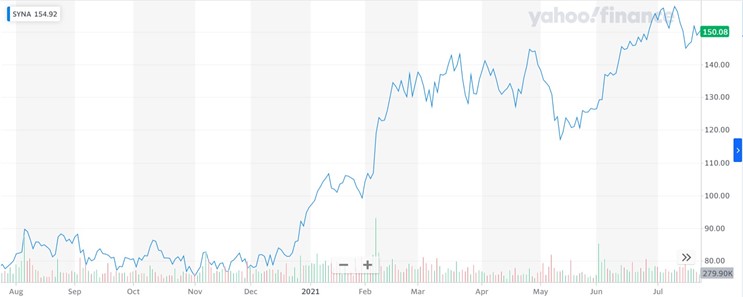
We’ve been working with Synaptics for about two years now, and are an ideal client for us, because of the industry they are in (semiconductors) and how we are working together. Our primary role has been providing content development and media relations – so helping develop the story lines around their products and the company itself, and then trying to get visibility through earned media. We’ve also worked with them on owned media content, such as their blog, web site and social media. The key is for all the content to build from a consistent messaging strategy, which is sometimes difficult for a company as diverse as Synaptics with varying product lines and customers. One way we’ve been working to up-level the story is through the themes – such as the evolving post-Covid workplace and the technology we use at home – which encompass several products and can be talked about in a more integrated way. But, what matters most is that they have truly innovative products enabling really important trends in how consumers and businesses use technology. And of course, in the context of appearing in the financial media, like CNBC, that they are attractive to investors.
Q: What value do you believe companies like Synaptics receive when working with PR firms like Wired Island? How does this differ from an internal team?
Two main benefits companies get from working with a PR firm are, first, an outsider perspective. Too often companies ‘drink their own Kool Aide’ and believe their own marketing and messaging is the only truth. And, they get bogged down in their own internal processes and bureaucracy. Working with an outside agency gives a different perspective and a touch point with audiences and influencers they might not normally get from an internal resource. So, we are kind of a sounding board, a reality check. Second is experience. We have literally decades’ worth of direct experience and relationships in the technology areas and market segments that matter to a company like Synaptics. And, most importantly, that experience is directly accessible through our model – unlike with a lot of agencies, all of our clients have access to our most senior people who are working day to day in hands-on mode with them.
Q: Fill me in on how you were able to land this spot on CNBC, was it a team effort? Timing with trends in the market?
I’d say that expression, “I’d rather be lucky than good” kind of applies here, but I don’t want to trivialize the effort that went it to this, either. Almost every publicly-traded company wants to land a spot on CNBC and Synaptics was no different. But there are hundreds of companies these shows have to pick from — and that pitch them – every day. We actually started re-introducing Synaptics to the Mad Money team almost a year ago, when Synaptics was just beginning a true transformation under its new CEO. Synaptics had been on the show previously under a different CEO a while ago. So, we had some existing knowledge and relationship to work with, but it was still a matter of persistence and patience on our part. Plus we had to present a newsworthy story to the producer. Broadcast opportunities like this are all about the here and now, so timing is also key. One challenge we faced is that Synaptics is not a huge company by industry standards. But on the other hand we had a great asset to work with in CEO Michael Hurlston who is a very articulate and quotable executive. I think ultimately what enable us to get the Synaptics story told was that it was really compelling and relevant in the moment. Pivoting to new, higher growth markets, well-known customers, nice rise in stock price; and significant improvement in financial fundamentals especially profitability – this is just the type of company CNBC watchers want to learn more about. And, of course, we had the PR tailwinds of macro issues like chip shortages, Covid buying patterns, and even the China trade war – which Synaptics has insightful perspectives on – to add a sense of urgency and relevance to the story. All of that gave us a lot of ammunition to work with. It still took some time to get the commitment from Cramer’s people, but eventually our “measured persistence” paid off.
Q: Do you believe this has opened opportunities for Synaptics going forward?
Yes for sure. We already had some pretty good success with Synaptics in places like The Wall Street Journal, Barrons, Wired, Venture Beat so I think maybe that helped a bit in landing the CNBC segment. And yes, success breeds success with this type of thing. But really without a good story you don’t have a chance. Synaptics has been an outstanding stock and the Wall Street analysts have been bullish on it. So Synaptics has a great story right now. The stock price jump alone over the last year is really eye-catching. I think other media probably look at an appearance on CNBC as a bit of a validation that the company is the real deal but I’m not sure it influences them to write. I think generally Synaptics has punched above its weight PR-wise, thanks in part to our persistence and opportunistic approach, but also because their CEO ‘gets’ PR and is supportive of it. That’s a big aid in doing what we do. As long we can keep showing success and traction through new products, real innovation, customer wins and, of course financial performance, I think we can keep their visibility high, particularly because semiconductors are in vogue at the moment for all types of media.
For more of our results on Synaptics see here.




Copyright ©2026 | Wired Island PR. All Rights Reserved
Privacy Policy